I am all things to all people. As long as people are looking for a mom with diverse interests and a homebound tendency to look through the window of life and wish (or imagine) something just a little bit different.
I am like the Tardis on Doctor Who. I am much bigger on the inside.
View all posts by kirizar →
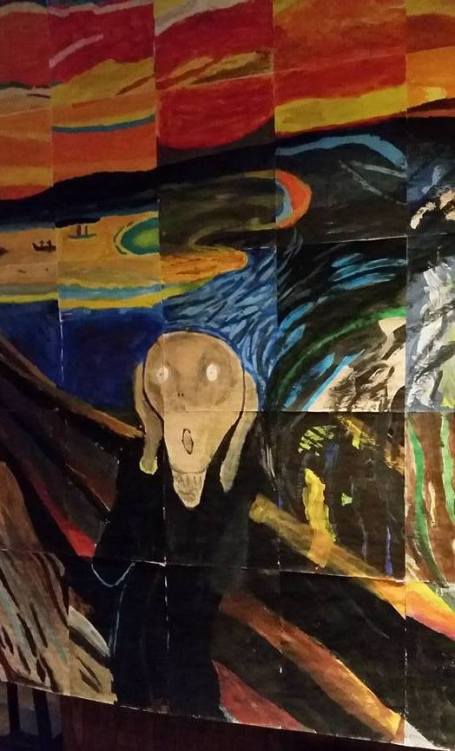
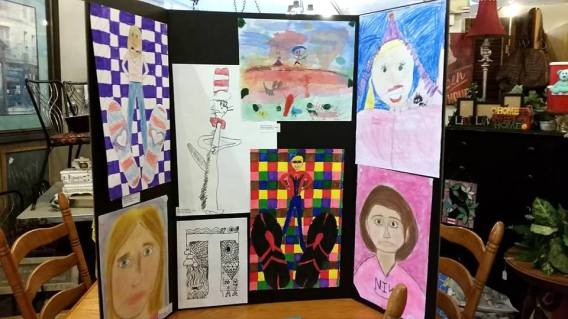
This is one of the hardest questions to answer, not the least of which is because it is transliterated from Russian. It asks: “What is art?” I ventured forth one night to consider this while exploring that regional delight: the hometown art fair.
Hands-on Art: If you look in the lower, right-hand corner, you will see the first two tiles placed by me and my son. We used up his patience waiting for the cement to set up.
Yesterday, I took my son to the Art & Chocolate Walk in Grandville, MI. Families gathered to share tidbits and admire local amateur artists’ works alongside school children’s efforts. I will say now, I am no arbiter of art; I have not studied at the Sorbonne, nor could I tell you the effect Prussian blue had on the impressionists. What I can tell you is viewing art at the speed of sound is a blurry challenge. (My son is not known for his love of art–unless it is of the deconstructionist variant and it involves either indelible ink or an expensive piece of technology.)* Destructive self-expression aside, my son preferred gobbling the candy and cookies to exploring the meaning found in artistic media–regardless of what form it took.
Among the exhibits under flapping awnings and propped on rolling stages was the very popular human statue. Parents would lead their unsuspecting child up to the copper-hued sculpture, asking their opinion about the work, only to hear the children yelp, “It moved!” followed by a spate of giggles when the work of art waggled a brush at them before returning to a frozen stance. Is this art? I can’t say. What I will say is the kids liked it and the man did a great job. He was up there the entire time I visited the fair staying in character–except when he broke the third wall–to the delight of onlookers. That shows talent in my book.
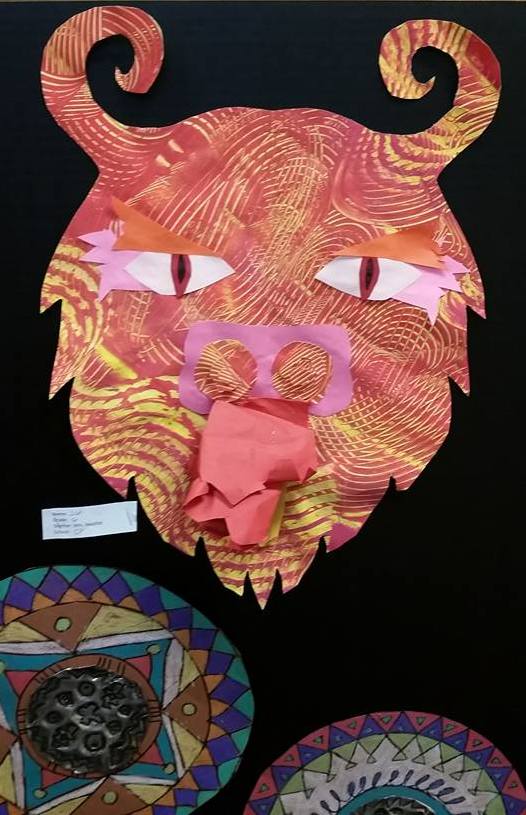
Owls were the popular patronus of several artists–but this one by far was the most fierce creature.
The art exhibits were cleverly spaced throughout the local business establishments. The chamber of commerce committee that dreamed this up earned their pennies.
This piece was among my favorites for its achingly honest child’s reflections on what makes her ‘hart’ mad or glad. “My hart is mad wen my Dad brns pancakes.” “My hart is Mad when my bad is mest up.” and “My hart is kom wen I grime my horis.” Truly spoken, every word. I am only sorry my arm was jostled taking the picture, but I had to share these heart-felt sentiments.
There is something odd, at first, about squeezing into a dress shop or past floor tile samples to view whichever school group or work was displayed, but plucky people managed it. After you grabbed your treat and had your card punched, you could wander through the stock to find the exhibits–it was surprisingly fun.
The Art of Cookies – a very popular exhibit for my son.
We zipped through one store where grandfather clocks competed with chiming glass-and-mirrored wall clocks which signaled the changing shifts of visitors to the small table of glue and paper efforts by the local elementary students.**
You know, somewhere, there are proud parents putting stuff like this up on refrigerators across the nation swearing it is the most beautiful art they’ve ever seen. And in doing so, it becomes the truth.
To some, this marketing of community businesses through parental pride might strike a mercenary note, yet I couldn’t help but admire the effort it took to put this on. Someone organized the local shops, the schools and teachers, the musicians and artists to contribute–time, money, energy and enthusiasm. Behind each cardboard easel you’ll see a deeper purpose–to nurture budding talents and to give pride of place for children who can go somewhere, point to a piece of work and say, “That one’s mine.” while the world looks on.
Everywhere I went, in the brief moments of admiration for some truly talented youngsters, I saw moms and dads escorting siblings and taking candid shots of performances and works by their children. Some children were shy about it, others wore smiles so wide it is hard to imagine a frame large enough to fit all those teeth.
This piece was hanging, appropriately enough, in a bar.
Where does art comes from? What inspiration springs from the soul and dares to express itself in song, sound, or acrylic paints? When does it actually happen?
What I liked about this, you can see children on the edge of becoming. The pretty princesses are turning into young women who have deeper feelings that can’t be captured with a sparkly tiara. (The boys, however, are still superheroes riding giant hover board shoes and wearing shades.)
Was there a budding Renoir or Matisse among the earnest, dramatic and sometimes cute artwork? From what I could see, yes. I was astounded at what was produced–either as a collaborative effort or even a derivative style, it was still very much art to me. Perhaps it was the nascent, newly-birthed foal version of art, just finding its shaky legs and looking for its mother to lean on, but it was art.
Art is: A giant snowflake. A happy robot in the city. A building leaning into a boysenberry sky. A tree…no, a boat…no, maybe a ship with a multi-colored umbrella braced by the setting sun. Or maybe art is a sleepy giraffe being woken up by an owl who is obviously throwing a noisy party.
All artists start somewhere at a place of beginning, staring at a blank canvas and wondering how they can speak to the world through a charcoal pencil. How does a child scribbling one day turn into a world-renowned artist? At one point, someone put a pencil or crayon in their hand and told them, “Draw me a pretty picture.” This, this is where art starts.
*
I wanted to include some of my favorites, so scroll below to see what I could see in the short amount of time my son allowed me.
Asterisk Bedazzled Footnotes:
*His first work is entitled “A Study in Red” because he squirted red food coloring all over the cream carpet in the living room. It never quite washed out. I hope the new home owners aren’t standing over the Rorschach-esque designs speculating whether a murder took place.
**If I confuse which grade of art was placed where, forgive me. By my fourth piece of dessert my concentration suffered from sugar overload.
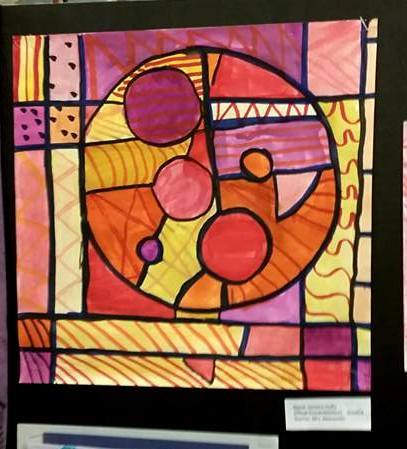
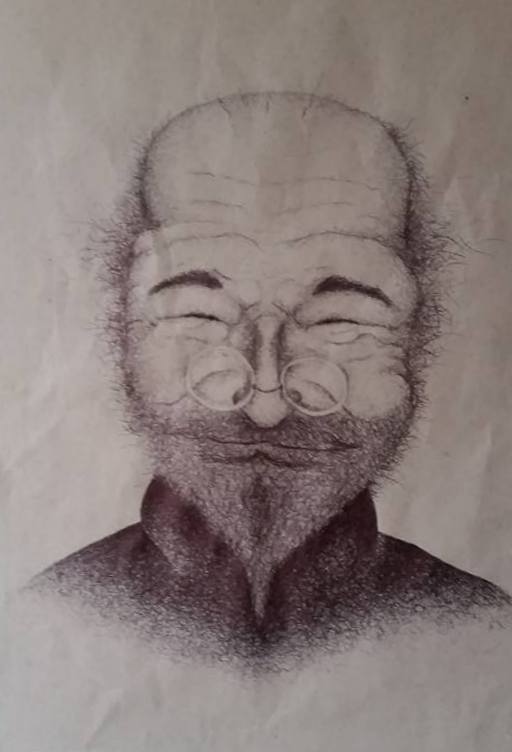
I don’t know why I liked this one so much, I just did. It is bold, it is bright, but it has hidden subtleties and I can feel myself leaning in to absorb it even now.Totally eye-catching toys; it was the first thing that called to me through a window. I had to maneuver to find it…and the more I looked at it, the more I liked it. The composition seems simple, but the shadows and whimsy perfectly captured that feeling of childlike exploration I felt while viewing the exhibits.I don’t know exactly what Seva Terburgh was hoping to convey, but what I took from this is people need to stop poking and petting babies. They don’t like it. The media was marker and watercolor…done by a 9th grader, people!I’m really enjoying this fish collage! Swimmingly done! Kudos to Emma Gardner, grade 9.Sophie Diekevers created this ink pen piece. I found it very disturbing, and not just because a 10th grader is this talented. Do you know hands are considered one of the hardest things to draw? Look at those hands, will you?Calla Heald, a 12th grader with a puckish sense of humor and a massive talent for wielding an ink pen like a master.I really like the art teacher who came up with such a dramatic piece. I admired every dragon and decorative tin wheel I saw.Who says a rooster can’t be a masterpiece? Look at the effort this took!If I had to pick a Best in Show, I think this piece–done with charcoal and graphite–would be in the running. Might I point out the artist, Jessica Abraham, is a 12th grade student at Grandville High School.This one covered the entrance wall of a local restaurant: The Rainbow Grill. I bet no one left that place without first ordering ice cream.Ultra Modern Art.
There is a manic busyness to butterflies that reminds a person that life is short. On average, a butterfly lives about a month, which is practically a luxury when compared to the mayfly which lives as an adult for less than a day—time which is basically spent reproducing before giving up their tiny ghosts. There is a lesson in this, probably.*
It’s hard to take a bad photo here, but going out at noon when the shadows are flat helps.
Because the human life span promises an extravagance of time, we tend to play fast and loose with our possibilities. We waste time to a degree that that Mother Nature shakes her head and throws plagues and severe storms at us for the occasional wake-up call. I was reminded of this while photographing butterflies at Meijer Gardens this weekend.
“Tower to Echo leader, Bravo leader is coming in hot for a landing. Prepare crash teams.”
Saturday, I shutterbugged my way through hordes of Vitamin-D deficient, pale mid-westerners who frolicked in the sun like they forgot what the glowing ball in the sky meant.** It was a good day to be out. Bright, warm. If I hadn’t had a raging headache, the day would have been perfect.
“Abort landing, Bravo. Pull up! Echo has claimed the landing leaf and isn’t budging, the wanker! Tower out.”
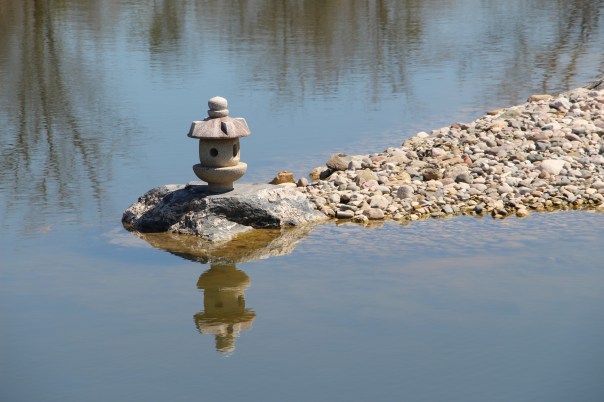
A babysitter sprinted after my son who was like a hound off his leash, allowing me the privilege of a leisurely inspection of the Japanese Gardens where incipient spring threatens pollen bombing if the warm weather continues.
“I’m ready for my close-up, Mr. DeMille.”
In my haste to worship the sun god, I neglected my hat and sunscreen routine. After ensuring that I’d exposed myself long enough to accrue a good case of sunstroke, I scampered inside to jam myself between iPhone happy strangers all trying to immortalize terrorized butterflies in unwilling selfies in the arboretum.
Black and White – A dramatic pause on a posy.
April signifies the end of the Butterfly Exhibit—a seasonal tradition at the gardens guaranteeing huge crowds as winter slips its stranglehold on the state. It also signals the end of the butterflies’ tiny life spans. Maybe it was just me, but their ragged wings and spastic flapping seemed tragic even as I too tried to pin their image to a digital cork board. It’s a macabre pastime only ameliorated by the lack of chloroform and a ‘humane’ practice of letting the poor things live out their sexless lives, out of season, trapped in a giant glass prison. I quash my guilt in order to enjoy myself.
Would it kill them to introduce one female into the group? Would it?
Throbbing skull aside, it was a perfect day. [Cue Ominous Music.]
We’re walking back to the car when, suddenly, I realize something is blocking the vision in my right eye. There is a shadow pantomime something like a stick and a jellyfish sword fighting wherever I look. I’ve had similar incidents in the past, but nothing on this scale. I’m not the brightest girl in the world, but, taking the headache into consideration, it occurs to me something might be wrong.
A visual representation of the butterflies churning in my stomach.
I scurry home, upload my pictures (because, hey, priorities), and chat with a friend to ask her opinion. She agrees, it is probably a floater and it’s no big deal. Because I suffer a certain amount of paranoia married with an overactive imagination and access to the internet, I come up with a different conclusion: I’ve detached a retina and I could lose my vision altogether.*** I call my friend who is a doctor, she says, “It’s probably nothing, but at your age with your severe myopia it could be a detached retina. If you can, you should have it looked at.”
Butterflies are fluttering, nihilistic harbingers–just better dressed than most.
Fast forward to an emergency visit to an ophthalmologist’s office, and she confirms it: “It’s just a big floater. We’ll have you come back in three weeks to see how it’s doing.”
Looks harmless. Total death merchant.
So, there you have it, butterflies are pernicious omens of ill will and doom, signifying the end of all things. Of course, that could just be the dancing jellyfish in my eye playing tricks on me.
Asterisk Bedazzled Footnotes:
*Mayfly mantra: more sex, less effing around with laundry and shit.
**We had. I call it winter amnesia.
***This is aptly called free-floating anxiety. Also, part of me wants to call this a detached retinue–because all of the voices in my head have abandoned me to run around in a panic.
Sorry, I was sucked into the vacuum that is Spring Break with a hyperactive child who has an overdeveloped sense of curiosity and underdeveloped sense of self-preservation.
The brain trust is drained.
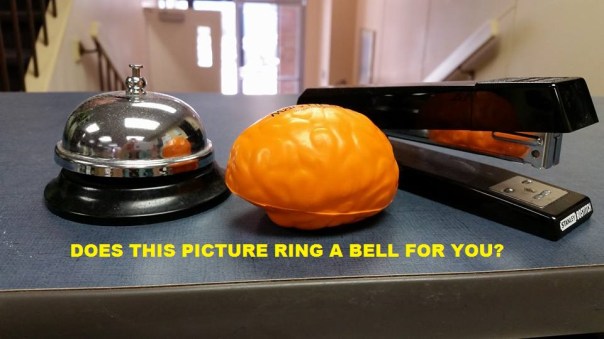
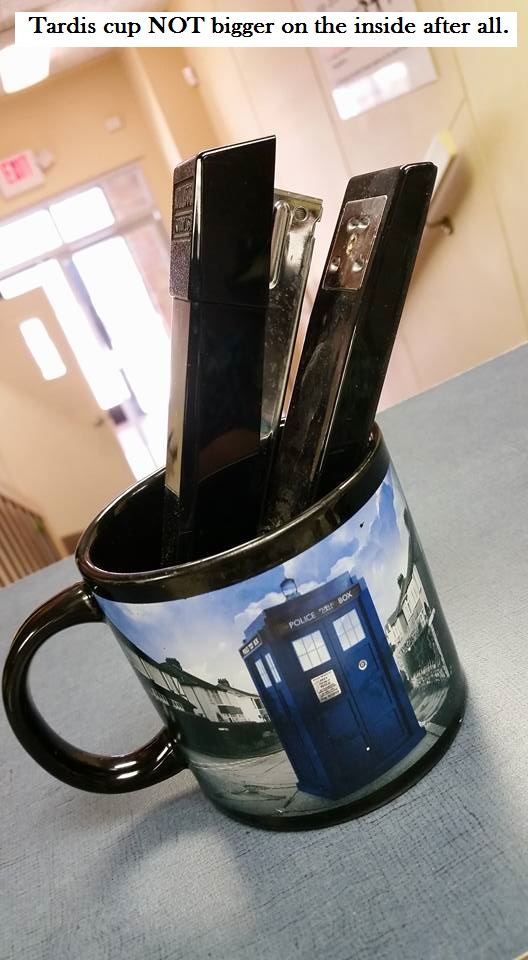
For your amusement, pictures I took with my Samsung phone at work today:
This entire post is in response to something at Writers of the Rain said about there not being an interesting picture of a stapler. I disagree! I now challenge everyone else to find or create their own interesting stapler photo.*
Have you ever watched a cup of water? Not in a cloudy-clear glass sitting still on a Formica table at a diner where you expect 1950’s bobby socks and poodle skirts to walk past, and where the waitress wears a mustard yellow uniform in unflattering polyester and has the nametag Flo or Madge stitched crookedly across one breast. No, I’m describing a hot cup of water in a black coffee cup carefully monitored as you carry it back from the tea pot or microwave, water that is potentially scalding, where a wary thumb and forefinger clutch a handle tight to avoid brushing the surface of the mug. Have you ever wondered what the water was thinking?
Ripples quake in the ceramic depths as you navigate the stairs—equal attention on the precarious balance of supporting the contents without it sloshing over and making sure you don’t trip on the risers causing the same outcome. The water is a mirror which reflects glimpses of the outside—a winter white light bounces and then catches your surprised face staring back at you. An impermanent, liquid mirror. And then it is gone again, in the ripples and splash of a miniature storm. This is probably where the expression comes from—a tempest in a teacup. Someone somewhere tripped and an expression was born of momentary carelessness. Will anything I ever say have the same lasting impact? Or must I bruise myself first and stumble my way to clichéd fame?
Does the water care that it once rocked oceans and ruled tiny coastlines—terrorizing small fishing boats, tossing them like broken toys to sink to the sandy bottom? Does it remember falling from the sky and running free through rock-ripped currents and over cataracts, emerging in tranquility to form a volcanic basin on tropic isles? Did this water wash the blood of battle fields and soothe the wounded and dying? Is there an echo of tears in every drop? Does the world weep when it rains?
This water is unaffected by the arts and schemes of human interference. It can be frozen but thawed, steamed but reconstituted, filtered but retains its elemental blueprint: two hydrogen and one carbon, atomic grace notes on a cosmic scale. It can be changed, but never altered. Added to, but never taken away, not really. For it returns from the hidden depths, the wellspring of glacial deposits and melt waters, pressing from the Earth like a sponge squeezed from the reservoir retained in once-living cells. If you drink it, you can taste the memory of its birth. The cooling sun of millions of years ago heated the first molecules to form atmosphere and fill in the gaps of a rocky ball birthed of pressure and centrifugal forces.
I stare into the cup and the universe stares back.
I drop in a teabag and go about my day.
In my TARDIS Cup, the tea is bigger on the inside.
Part III–the last in my series on Herrick Library’s Get Published 2016 seminar–will address the elusive topic of what things you should avoid when writing your master work. This isn’t a how-to so much as a how-not-to. [To catch up, follow the colorful links to review Part I and Part II .]
Borrowed from Humoresque by Loren Fishman at Toon Pool – may he forgive my larcenous ways.
*****
By the end of a six-hour marathon session of talking, the flower may not have lost its bloom, but the petals were wilting (and screaming to stretch already). I still enjoyed the camaraderie of the occasion—established writers, publishers, editors, joining in an effort to help new writers learn the ropes of publishing—but my note taking definitely took a nosedive.
The moderator asked what advice each person had for the beginning writer. As if a lid came off a pot threatening to over-boil, the panel devolved into a session of “Please for the love of god—no. Just, no!” pet peeves…ah, I mean…appeals.* Let’s see if you can pick out all the points raised in this sample text I’ve constructed for a story I’m calling:
A Godawful Mess
Jack said, “I need to pee.” as he rose from his bed. At the door he started to go, then he hesitated, stopping to scratch his pertinent private parts as if to suggest other options, but then went to the bathroom.
It was looking like it was going to become a boring day like every morning before and every boring day after forever and ever. His wife, who hated him with a passion that otherwise could only be found on her favorite daytime soaps, under her morning breath sparkled: “Just once, it would be nice if That Bastard,” her pet name for Jack, “woke up on fire in a tunnel full of rats with rabies and syphilis.” (Whether she meant the rats had rabies and syphillis or Jack did was anybody’s guess because she was imprecise in her attribution.) But his wife didn’t dare say this too loudly enough to chance to be heard through the cardboard thin walls of their hand-me-down trailer, in case her bastard husband who cheated on her since the sixth grade dance where he had decided to invite her, only to then decide to dump her for her best friend Brittany who later dropped out of college to become a poll dancer and went on to prancingly marry a wealthy plastic surgeon, heard her.
Tiffany crooked her head sideways to crane like a Frasier fir in a hundred-mile-an-hour wind and look across the room at Brittany-The-Bitchany’s portrait on the wall where her husband had punched a hole in a drunken rage following being fired for embezzlement which led to their current nearly homeless situation.Tiffany had a moment to consider a lengthy backstory, but she felt her gorge rising and decided to vomit in the laundry basket instead, scaring the cat.
Her mouth was whipped with the back of one hairy hand, Tiffany pointed a finger at the picture while picking up a dart to throw it. She missed, and instead hit PussyWillow the Third, scarring the cat. The Bastard would have said ‘Ten Points’ if he weren’t peeing like a race horse and stinking up the place. Damned asparagus festival. The sound of flushing woke her briefly from her stupor.
Wait…where was she? Tiffany began to stumble to her feet and think. Oh, right, reflecting on the duplicitous nature of a back-stabbing, would-be, erstwhile ho.
Brittany’s head covers the hole now and Tiffany likes to think someday That Bastard will punch Brittany’s face in. Brittany with her perfect hair, perfect family and perfect life. Tiffany’s complaining liver became suffused with bile and sneered at the former blond, high school prom queen/cheerleader/slut. Type-casting was rife in her opinion.
Waggling the pointed finger, Tiffany considered her foe with impunity.
“It doesn’t matter how far you’ve risen, Bitchany.” Tiffany brayed donkey-like through smoke-blackened partials, flipping her greasy hair for emphasizing measure. “I know how low you are willing to go–all the way down according to the varsity football team. I know those red-headed kids ain’t you’re husbands. And I know people in even lower places who are willing to pay for juicy gossip.” Tiffany chuffed and snorted her pointless speech with kale-like bitterness. She emitted sounds like a congested diesel engine on its last piston. Her glass eye shivered like molten jelly.
Brittany was stubbornly oblivious-her plastic smile oozing insincerely and unctuously from the flaking-off fake gold frame on the wall. Her capped teeth sparkled with egotistical glee under the glass. Her eyes said with extreme vivaciousness, “Well, lookee who here was a success and who got fat and cheated on after all. Pooh to you, Ms. Valley-dictorian. I guess getting a boob job was the right career path after all.”
“Shut your mouth, whore!”She said to her former best friend.
Spittle flew with projectile fury-spattering the frame in a lacy spray of flume and bile. Tiffany got right up in Brittany’s celluloid face and decided to consider to go get a shredder to deal with the conniving leg-spreader who’d done the nasty with Jack and then toasted Tiffany with the news at her bachelorette party.
“Good luck with Mr. Two-and-a-half.” Tiffany mouth measured mock suggestive, surprise as her fingers shrunk to the widening eyes of the circle of drunk family members.
Grandma had to about keeled over with shock and the minister’s wife prunned up something fierce. Mom still gave That Bastard funny looks when they visited her in prison. Daddy, may he rest in peace, had just laughed before shoving another dollar into her cousin’s g-string.
Not as drunk as she had been that night, Tiffany finally found the words that summed up her rage, jealousy and the vacillation of someone who hates the only real friend she’d ever had, except for the imaginary kind. Her hands shook like a rattler warning of an imminent bite, she said, “Bite me.” to the frame on the wall.
“What’cha bitchin ’bout now?” The Bastard belched each word with criminal flatulence for an oncore.
Over his shoulder, Brittany winked from the frame and blew Tiffany a kiss.
“Nothin.” She said.
“What?” He said.
“You heard me.” She said.
“Oh yeah?” He said before cracking her a good one.
“Touche,” she said.
“Merooooooow?” said PussyWillow the Third with a suggestion of a furball at the end of its vowel-laden yowl.
That Bastard said menacingly, “Shut up, cat.” before kicking the half-blind creature aiming for imaginary goal posts through the upright ends of the three-poster bed.
Regaining her feet, although she’d lost a high heel somewhere as she stumbled to a drunkly dignified pose, one bra strap slipping un-suggestively down her rounded shoulders, she said. “Happy Anniversary, dear.”
What she meant was, “I hope you die a thousand deaths under a scorching sun with fire ants chewing a path through your cocaine damaged nasal passages and eat the last unpickled neuron which keeps you breathing, you fart-breathed buffoon.”
“You too,” he breathed Johnny Walker on a nine-day bender back at her.
One of them was going to die a painfully ironic terminal death today…sadly, it was going to be PussyWillow the Third, but that is a story for another tale. Mostly we will just have to wonder.
Believe me, that was almost as hard to write as it was to read. Most of the mistakes are on purpose. Feel free to assume that any mistake in my writing henceforth is a test for you to pass. Your welcum. (Intentionally bad for you grammar pedants.) Which leads me to our panel’s most prevalent opinion–fundamental writing skills matter.
English Teacher Vindication
The most basic lament about first-time submissions was surprising—instead of a commentary on plot, character, or pacing, the panel agreed, what a publisher wants to see most is clean writing that is free from errors. Writers should, “focus on grammar—the publisher doesn’t want to have a lot of work to fix.” In addition to spotless grammar, the language mechanics have to be physically possible. One panelist said, “Eliminate flowery or impossible speaker attributions. You can’t smile or laugh dialogue. Stick with ‘he said’ or ‘she said.’ In a dialogue between two people it is possible to avoid attribution or just do the minimal if it is well written.” Simple fixes such as these are the key to a clean manuscript. Matthew Rohr suggests writers need a checklist to use as a guideline to proof your work, “When I am writing a story, the first and second draft are rough outlines—the second draft is when I edit with a check list of things I watch out for: grammar, passive verbs, etc…” Once you have the skills of a ninja grammarian, you are ready to move on to the fun stuff: getting to the nitty gritty, low down and dirty, totally balls-to-the-wall annoyances of choppy writing.
Each writer had their own particular focus for what distracts the reader from making it through the minefield of bad writing.
Flashback = Drawback
Sue Ann Culp eschews the tried and true flashback, stating that the first chapter of the book should stay in the present. “In the first chapter there should be no back story.” Apparently, any time a writer stops the action this causes “broken narrative—don’t stop for backstory.”
Bad Bedroom Scenes
Sue Ann Culp also begged writers to avoid a certain type of bedroom scene. “Please stop writing your character getting up in the morning! Nothing of interest happens in the course of an ordinary day. Skip to the part where something different happens.” She did amend this blanket statement by adding, “Of course, if the story beings with ‘I woke up in a tunnel on fire,’ that’s a little different.”
On Introducing a Scene—How Not To:
“Please no Wikipedia entries detailing the story building of the world you’re creating.” Tim Rohr. “Though, it’s not a bad idea to write your novel as a short story and then back-scaffold out of it to find the plot points the story is going to follow.”
In his typically succinct fashion, Tim Rohr said, “Don’t lead with ‘Jack said.’”
Infinite Infinitive Injunctions
Tim Rohr’s writing process involves a lot of things to avoid, in particular, he suggests writers keep a look out for particular infinitive constructions. “Infinitive makers tend to flatten the narrative. Don’t use ‘to start’, ‘to begin’, ‘to proceed,’ etc…” He cited examples:
Instead of ‘He began to study…’ write ‘He studied.’
Instead of ‘She started to become concerned…’ write ‘She worried…’
Once you start to see it, it is easy to recognize where pacing begins to lag. “Whenever writers put infinitives into a sentence it slows the reader down and takes the legs out from under the action.” Tim Rohr prefers the focus to be on the movement of the story. “I ask myself, ‘Is the writing self-aware?’ In an action-packed scene, the sentences get shorter.” He ended with his pet-peeve: “I hate this type of sentence: ‘I hesitated but then went…’ Don’t do that.”
Adverb Annihilation
Sue Ann Culp apparently agrees with Stephen King who holds the opinion that “…the road to hell is paved with adverbs.” She had this to say about the pesky, unnecessary constructions: “Massacre the adverbs! Adverbs are a lazy way of writing and people over-use them. The dialogue should do the work. The body language that goes along with it will tell the story. Don’t feed me ‘Menacingly! Oh, and read everything out loud. I read out loud and my dog loves to listen to me.” Pet pronouncements aside, I have to agree with what she and the estimable Mr. King are saying—mostly. Sometimes, no other emphasis will do. Just be certain adverbial inclusion is crucial, or prepare to be skewered by overzealous editors with giant, red pens of critical justice.
In Defense of Decent Dialogue
The presenters segued to a discussion of dialogue and recommendations flew past. Sometimes, in the heat of writing, you don’t recognize the error of your ways. Matthew Rohr pointed to the obvious solution. “You need to have a list of things to cross-check when you think you are done and ready to submit. For me, I check attribution—the he said, she said count. If there are fifty ‘saids’ in a 200-word paragraph—that’s bad.” Matthew went on to recommend samples of dialogue from the current anthology from Caffeinated Press. “One of the stories by AmyJo Johnson in the Brewed Awakenings anthology has a story with great dialogue. And Melanie Meyer’s story “The Watcher on the Island” is another.” Fortunately for you, I happened to purchase a copy so I am able to report that he is quite right to recommend these authors. I liked both short stories very much, but going back and reading for the impact of dialogue made me think about why I liked each story and how the use of dialogue impacted my opinion.
The story, She’s My Favorite by AmyJo Johnson, uses dialogue to drops hints about the mystery between sisters in a futuristic world. The key to this character-driven narrative is the unusual, stilted exchanges between the main character and her emotionally distant twin.
“Sister, how old are we?” Lily had asked, when they were alone one evening.
“Five.”
“How do we know when we are six?”
“Mother will throw a party, where other kids come over, bring toys for me, and we get to eat cake. You’ll get to watch, like at the playground.”
“A party?” The word sounded magical to Lily. “Why haven’t we had a party yet?”
“Last time, we were too young. The other kids told me about parties and that they start when we turn six.”
In this short story, the author uses the telling questions to reveal the unequal treatment for the child described as ‘Other’ but not necessarily the reason behind it until nearly the end. There is no backstory to speak of and little description of the setting beyond the bleakness of the narrow world as viewed through Lily’s eyes. Without beating the reader over the head, the author increases the understanding little by little with short conversations between twins who are raised in very different ways. The simplicity of the scenes and the questions which go unanswered tell much more than a detailed exploration of world building that occurs in larger works. Conversely, in The Watcher on the Island, by Melanie Meyer, the everyday exchanges between a boy and his playmate do nothing to raise suspicions—it is the setting and circumstances of the relationship which suggest that something is different about Tartok’s friend, Raven.
“Do you have time to come see the cave?” There are icicles there as long as my arm!” Raven asked excitedly.
Tartok looked to the sun, which was only a hand-width from the horizon, and said, “Probably not today. It’ll be dark soon and Mother hates when I am out after dark.”
“Alright, But if we don’t go tomorrow, they will melt.” Raven got to his feet and brushed dirt and dried bird droppings off his pants. “You’ll come to play tomorrow won’t you?”
“I’ll try as hard as I can. It all depends on when the Japanese patrol comes past, Mother won’t let me out until they are gone.”
Raven just shrugged, and walked up the hill alone as Tartok walked back to the lone fishing hut that clung to the battered shore. It looked like it had been abandoned for years, and Tartok knew that was the point. It didn’t look very inviting. Still, as the winter wind blew around the rocky cliffs, Tartok found it much better than this otherwise desolate island in the middle of nowhere.
In this story, dialogue does not work alone to set the stage, but it does realistically imitate two boys playing as if in an ordinary world. Tartok’s matter-of-fact acceptance of Raven’s friendship on an otherwise deserted island gives the reader a chance to identify with a lonely boy’s ability to ignore obvious questions. There is a magic to a child’s willing suspension of disbelief in time of war and privation—the simplicity of their exchanges leads the reader to believe the impossible must be true. Whether stilted and painfully correct or casual and childlike, the dialogue is a mirror to the character and the character a window to the soul of the story. Being able to recognize when you have gotten it right is the hardest part.
Dialogue works best that sounds believable, but it surprisingly hard to create. In researching the topic, I ran across an excellent article on the subject at the Aliventures Blog. It offers some links to the mechanics of formatting dialogue and identifying the mistakes neophyte writers are prone to make. And on that subject, our presenters had a few recommendations.
Well written dialogue sells the reader on the story; it is the frosting to the cupcake. Yeah, you might have a moist, cake-y concoction, but a story is always improved by a swirl of delicious dialogue.** However, if you don’t layer it just right, sticky dialogue might leave your readers with a bad taste in their mouths. For example, Jason Gillikin is passionately opposed to clunky speeches: “Don’t over-prescribe the dialogue. Ellipses make me mad. Let the reader draw their own conclusions.” Writers fall in love with their words—to the point even professional writers might miss glaringly poor construction. The solution to this problem? It’s as easy as a robotic voice-over. AmyJo Johnson recommends a program which will let you hear just how bad or good your dialogue is. She recommends writers “Use ‘Open Office’ as it will read your work to you—in a horrible, automated voice—but at least you get to hear it.” Once you listen to just how bad it sounds, flat dialogue starts to stand out and you are able to identify the error of your ways and eliminate it from your writing. So now you have a better idea how to put words in the mouth of your creation—but how do you decide whatexactly you are creating?
Pants Versus No Pants
The panelists were asked what approach they preferred when starting a novel—are you a planner or a pantser? The consensus? Most people are a little bit of both—or at least maybe they should be.
If you line up a row of writers and asked them whether their process is highly structured or flows organically from a primal literary spring, expect there to be a giant line drawn in the sand with die-hard opinions on both sides—at least, at first. “I’m a planner.” Tim Rohr said succinctly—as if that said it all. His brother, Matthew Rohr waxed a little more poetic—and from the other side of the fence. “I have no use for planning. But I recommend that you pair up with whoever is an opposite to your writing style. My brother is a planner and we have bounced things off each other.” It’s all well and good if you have someone to bounce ideas off of, but in a pinch, sometimes your characters can tell you where they want to go.
What is a writer to do when the road ahead isn’t so clearly mapped out? Amy Jo Johnson, recommends you let your characters out to play. “I’m a pantser. I like to write up my characters in a world, like The Sims, and let them loose and see what they do. You have to find ways to get into your characters’ heads.” This laissez-faire attitude didn’t work for everyone however. Jason Gilliken was unapologetic about a more meticulous approach. “I’m a planner.” With that said, Jason did recommend however that even a planner needs to recognize that a work is dynamic, subject to change and will have an organic core. “I recommend you leave the first draft alone for six months. A cold read is a refreshing start.”*** Every writer knew what their preferred method was, but did not suggest one method was better over another. Heads nodded as each person presented their take on the most difficult of journeys—from the beginning of a story to a satisfying conclusion. Sue Ann Culp is a self-professed planner, but even she concedes that flexibility is a key attribute. “I think we are all a bit of both. But when I get in the car, if I don’t have a direction, I go—[insert wishy-washy hand gesture here]—SWISH. I have to have an overall road map from the start.” Right, so it’s great to go sightseeing but if you lose the map, expect to make unnecessary detours and backtracking in your writing.
Leaving the presentation, my head buzzed with the many ideas, recommendations, and admonitions. In general, I like to write from my heart on subjects with which I am familiar. This series was a step outside my comfort zone. It was a struggle to condense the advice and weave it into a whole cloth for you to wrap your head around. I am not entirely sure I succeeded, but I am glad I made the effort. Of note, there was one portion of the session I did not write about. It was the live critique of work submitted by attendees of the conference. As the audience looked on, each work was diced into so much blow fish sushi. Fugu might be delicious, but one wrong slip and it is also poisonous. After listening to the points the editors and writers made about other people’s works, I was grateful mine hadn’t been chosen. Because I do not have the original works to reference, I felt the points raised in the critique—though helpful to the writers and audience—would not make sense out of context. Then, I had a bit of luck. At the end of the session, I won a prize: a critique of my work by editors from MiFiWriters.org. When I have heard back from the reviewers, I will let you know what they had to say. Just as soon as they stop laughing.
Asterisk Bedazzled Footnotes:
*Feel free to let me know how to correctly punctuate this sentence. I rewrote it several times and finally gave up. Sue me.
**Mmmmmm, rich and tasty dialogue. Chocolate ganache colloquy is my favorite.
***However, waiting four weeks after the event to write a final installment blog post is ill-advised. You end up with the rambling mess you see above you.
Sue Ann Culp – playwright and author, writing professionally for over twenty years. Her fiction has appeared in magazines such as Wee Wisdom and Kaleidoscope. Her stage play is being presented at the Holland Civic Theater, “The Lies that Bind” was named one of the top 100 plays of 2009 by Writer’s Digest. She teaches fiction writing for children and teens. Visit her website at SueAnnCulp.com.
Jacqueline Carey – New York Times bestseller, author of the critically acclaimed and award-winning Kushiel’s Legacy series, The Sundering epic fantasy duology, and the Agent of Hel contemporary fantasy novels www.jacquelinecarey.com.
Eileen Wiedbrauk – a paranormal fiction writer and Editor-in-Chief of World Weaver Press, as her bio describes, she is an editor, writer, coffee addict, cat herder, MFA graduate—among other things. Websites: World Weaver Press a mid-size publishing company andRed Moon Romance–a site that, by the look of it, just might warrant a sizzling NC-17 rating.
Kristina Wojtaszek (whose name I mangled in my notes) – self-professed former woodland sprite and/or mermaid growing up around the shores of Lake Michigan. She has a bachelor’s in Wildlife Management. Her focus as a writer reflects her interests in fairy tales, ghost stories, poems and YA fiction–published in World Weaver Press, in Fae, Specter Spectacular, and Scarecrow, and in Far Off Places, and Sucker Literary Magazine. Follow her blog at Twice Upon A Time.
Brittany Wilson – Treasurer and Chief Financial Officer of Caffeinated Press is a jack-of-all-trades — writer, editor, finance ninja, and NaNoWriMo Municipal Liaison. Brittany has a degree in investigative accounting and a minor in creative writing. She has earned a partial bachelor’s degree in Japanese.
Jason Gilliken – Director Editor for Caffeinated Press Jason earned a degree in moral philosophy and political science–apparently he is not adverse to irony–with minors in history, Latin, and comparative religion and is currently pursuing a graduate certificate in applied statistics from WMU.
Matthew Rohr (one of the Bookend Brothers, so named for their seating at the table)-writer and editor of short stories and novels in the Urban Fantasy, Historical Fantasy, Science Fiction, and post-modern, pre-industrial retro-futuristic steampunk haiku-funk fusion genres. (The last genre may or may not actually exist. He is still thinking about it.) He is a founding member of MiFiWriters and editor of various editions of the Division by Zero anthology.
Tim Rohr(The other Bookend Brother) – A graduate of Hope College, Tim is a writer and editor and one of the founders representing MiFiWriters – a Michigan Fiction Writers collective http://www.mifiwriters.org/ focusing on speculative fiction and producing an annual Michigan Writers Anthology entitled Division by Zero. He runs the Monday night writers group for Herrick Library. He can be found at his eponymous website.
AmyJo Johnson – Business leader and corporate trainer, personal trainer and enthusiastic participant in all things related to Minnesota athletics–Amy Jo leads CafPress’s marketing endeavors. Caffeinated Press
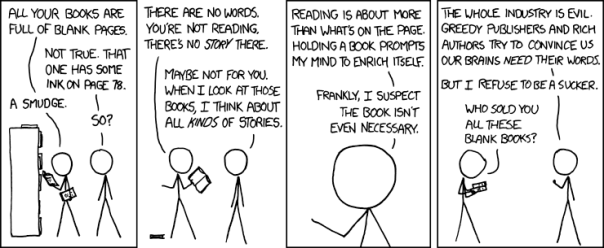
Write a brilliant novel. They said. How hard can it be? They said. (Artwork borrowed from http://xkcd.com/971/)
You are ready to publish? Congratulations! But are you prepared to face the literary gauntlet? The Herrick Library Get Published! 2016 conversation continues from last week’s fantastically titled Session I with insights from all the presenters on what constitutes the write right and wrong ways to approach a publisher or literary agent.
Query letters are similar to the cover letter which accompanies the curriculum vitae or résumé in a job application. How hard can a letter be? You may ask. The panelists caution that the letter is the first thing a potential editor or publisher sees of your work—some writers are rejected solely on the basis of a poor cover letter. Think of it like a dating profile—you’ve got to put forth the best version of you (and your work) possible. The best way to learn is by example…and here is a definite worst-case scenario:
Count the Mistakes in this Sample Query Letter
Dear Meow Mewo Productions:
I know you aren’t excepting submissions right now, but I have a number one best seller which will make the DaVinci Cod weep with envy. You would be a fool not to hear me out. I have thousands of pages of notes and all I need is a $50,000 advance to begin writing. I have sent my summary to several of your competitors, such as Harlequin Romance, Field-N-Stream, and Publisher’s Clearing House, so time is of the essence. He who bites first gets the fish.Continue reading QUERY ME! QUERY ME REAL GOOD!→
Brace yourselves, ya’ll, it’s about to get literary.
I attended the Get Published! 2016 Writer’s Workshop this past weekend at Herrick Library in Holland…Michigan…not the country. An unexpected nose bleed (not mine) delayed my departure.* Because of my late arrival, I had to not-so-surreptitiously sneak into the event and plead for a chair to be set up in the back because I was too embarrassed to crawl to the middle seats in front of everyone. Then I dropped my snack apple—twice—so didn’t get to eat until the first break. I blame any errors in my notes on low blood sugar.
This post is intended to boil down the advice and recommendations and perhaps some of the enthusiasm of this past Saturday. There is just something about feeding your literary aspirations with a six-hour diet of concentrated study that is both invigorating and daunting.
Each panel was arranged from a pool of eight representatives from the writing industry: publishers, a playwright, fiction writers and editors—most of these people wore more than one hat and all had something to say. (The list of attendees can be found at the foot of this post.)
I can’t recapture the entire presentation here—even if I wanted to, my note taking skills aren’t that good. In an effort to maintain sanity, I will be breaking up my notes into as coherent an organization as I can manage. Today’s topic was one of my favorites—the first presentation was called “Character, Point of View and Voice”. Honestly though, the talk wandered whichever way the questions led it.
* * * * *
Building More Interesting and Believable Characters:
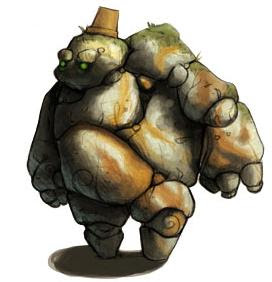
This is a golem–he will be good, if you write him that way.
As readers, we cherish a well written character—fully fleshed out with a recognizable voice and believable motivations. Fully-formed protagonists and devilish villains are the peaches in the pie, so to speak. As writers, it can be very difficult to figure out why what we have written is about as dynamic as poorly-designed stage scenery. In the first session, the moderator introduced the question of how a writer goes about constructing something more lifelike than a clumsy homunculus sculpted using Roget’s Thesaurus and a trowel of desperation. Not surprisingly, the panel differed in their approaches—some prefer internal mechanisms of constructing motive while others recommend stalking the populace to feed your imagination.
In life, people are haunted by their pasts and driven by their desires—characters in stories are no different. When you look at the stories you are writing, the experts suggest examining why your characters act the way they do. “Believable characters are going to have things that only they understand about themselves.” Tim Rohr. The panel was quick to point out this doesn’t mean that we ‘explain’ motives to the reader in a detailed, point-by-point fashion. When deciding how much backstory to present, we should keep in mind “what we want to include versus what we need to include. Characters are not their past—they are what we put them through. Backstory isn’t that interesting.” Tim Rohr. Sue Ann Culp piggybacked on this statement warning, “Watch for the moments when the author is talking and not the character.” The consensus opinion was that, often, exposition is the author not giving readers enough credit. Therefore, a cardinal sin of writing is the dreaded Info Dump: “As authors, we have a message we want to get out. It isn’t that it is not a valid thing to do, but you don’t want the reader to put it together until after the end of the story.” Matthew Rohr. If you want to write a believable story, don’t rely on the main character’s past to frame the narrative.
WHAT DO YOU MEAN I CAN’T INCLUDE BACKSTORY?
Hang on, if we can’t write about backstory, what should be put in its place? Tim Rohr recommends the story should be carried by the character’s actions and reactions. “If it is (interesting enough) you should be telling that story—(the characters) are the trials that we put them through.” An author instinctively wants to explain everything to the reader; to write well, we have to quash this impulse. Writing—Bob is running away from his life and responsibilities because a mid-life crisis had been building since his wife started talking about possibly having a third child—isn’t as strong as—Bob took one look at the booty his wife was knitting and left…for Tahiti.** The ‘write’ thing to do might just be keeping a few secrets for the audience to sniff out…but from whence arise these complex characters chock full of mystery?
FROM WITHOUT AS WITHIN
As Gods of Creation, writers may seek help from the world around them. A few panelists suggest that, if you need inspiration, it can be as close as the nearest coffee shop. “I’m a big airport eavesdropper. I will look around to see who is talking and then I will go sit behind them and listen to their conversations.” Sue Ann Culp. Another writer, Matthew Rohr, referenced gathering facets from people around him to create a composite of personalities, quirks, and appearances and stockpiling them for future use, calling this his “Bureau of Unemployed Characters.” Character studies already exist, everywhere around us—in the places we visits, our co-workers and family members; they are also available within.
The presenters recommend using your writing to act out the emotional upheavals or life conflicts and basically translate that into your work. “When you are first writing your story, you have to use it as a punching bag. Let your raw anger and angst come out. Have your characters express anger. Let your dark characters express the dark.” Kristen Wojtaszek. She went on to say, “What we as authors are doing is acting. When you write, you have to wear that character’s skin. Spend time daydreaming and put yourself into it…act it out.” Get to know your creations. Take them out for tea—find out if they like Oolong in light green, ceramic bowls or Lipton sun-brewed drunk from a canning jar with lemon slices and sweet enough to carve cavities on the spot. Once your fully-fleshed-out character is ready for action, the only way to test their mettle is to throw them into the literary blender and push ‘frappe’.
PERFECTLY IMPERFECT
Good writing is driven by more than just motivation, it is the balance of what the character wants to happen and what the author does to keep them off-balance with their goals tantalizingly out of reach. We can’t love our creation so much that we aren’t willing to put them through hell to write a good story. Brittany Wilson had this to say about character development: “Sometimes we fall into this trap…we want our characters to be perfect.” She described reading books where the main character has no flaws and that everything comes out happy in the end with little to no struggle. “You get to the end of the book and feel ‘I hate these people.’ Your heroes are going to be good, but they have to have some bad in them. And your villains are going to be bad, but they need to have some good in them. Lean more toward the middle.”
There is always something in the character people can relate to—whether good or bad.” So, if our good guy has flaws like any real human…our villain’s flaw is their niceness? Matthew Rohr explains that it is all about the audience, “The thing people identify with in a good character is their flaw. The best villains have an understandable or believable end goal.” Basically, the best villains are not Snidely Whiplash—they are not pure evil. They may have a goal the reader can agree with or even find laudable; it is the villain’s method of achieving the goal that is reprehensible.
IDENTIFYING WITH MOTIVATION = BELIEVABILITY
You can’t only wear the skin of your hero, you also have to walk in the shoes of the bad guy. Sue Ann Culp mentioned a story she read, I Hunt Killers—about a teenage boy whose father was a serial killer and the boy is worried he has these tendencies. “The dad in the story, in his own twisted mind, loves his son. He believed teaching his son the ‘family business’ was a thing a good father would do.” Writing reflects the duality of human nature—a character might justify killing several people to prevent what he considers a greater injustice. Viewed through this dark lens, what seems incomprehensible begins to make a terrible sort of sense. In fact, for the reader, the motivations have to be believable on some level or the story won’t float. The architecture of a tale does not rest solely on the actions of the hero—if you feel the conflict is one-sided, then perhaps it is time to take a walk on the dark side.
Bi-Polar Symbolism is not just for theater!
When you are stuck in the narrative and want a different perspective someone suggested that you “Re-write the story from your villain’s point of view.” Remember, that from the villain’s perspective—they are the good guy. Their actions might be misguided, stubborn, malicious, or just plain wrong—but the villain’s beliefs and desires will direct as much or more of the story than what the otherwise law-abiding hero does. Whether you are writing a good or bad guy, you have to remember that their motivations might not serve their best interests. “The needs and the wants of the character don’t always match up. Story conflict is a good place to build a character.” Brittany Wilson
WHAT HAPPENS WHEN YOU WRITE A BAD BAD GUY?
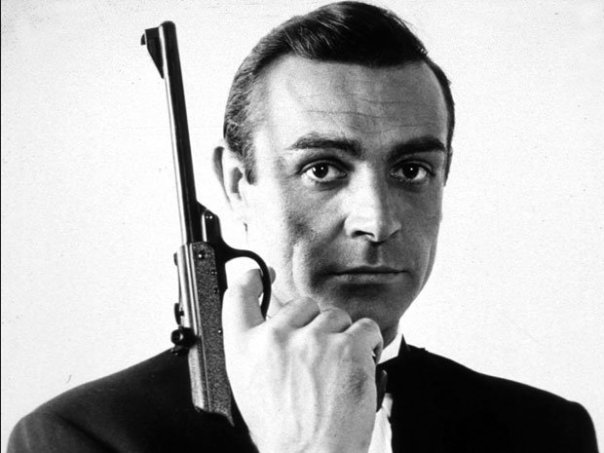
An overly-good hero is going to be just as bad as a cardboard-cutout, super villain bent on destroying Metropolis for no better reason than they can. As one of the panelists put it, “If you find yourself with a ‘Boris and Natasha’ character, you really need to flesh him out.” Sometimes though, when you are putting your first words to the page, you don’t know why the bad guy is the bad guy. Brittany Wilson suggests you should James Bond It. She goes on to describe the moment in every Bond film where “James Bond is strapped to a table, surrounded by sharks, and the evil villain is sitting in a chair stroking a cat and he says, ‘Now that I have you, Mr. Bond, let me tell you my reason for my nefarious actions…’ and then bad guy explains his actions and motivations.”***
James Bond: “Do you expect me to talk?” Villain: “No, Mr. Bond, I expect you to write a believable character!”
The idea behind James Bonding It is to use the first draft of a novel to outline the bad guy’s motivation. Write the scene where the bad guy has the hero helpless and cackles maniacally about his or her life of crime leading up to this singular moment. You can go back and cut the Monologue of Villainy after you have a clear idea of why and how your bad guy acts the way he/she does. Once you understand the why, you can construct the how–let those convictions direct their actions and frame your story.
First Takeaway:
You have to know your characters inside and out; but, when you write them, you show who they are by their actions and their words and a limited amount of internal dialogue and little to no backstory. No one is all good, or all bad, remember to Lean to the Middle. Once you have well-drafted characters, remember to give them hell—conflict is the oil that greases the works. And, lastly, when in doubt in creating your villain, James Bond It.
Asterisk Bedazzled Footnotes:
*Nothing like finding your child in a pool of blood in his bed to give you heart palpitations.
**This example brought to you by a neophyte writer—where better doesn’t always mean good. Also–Tahiti sounds like the name of an exotic dancer, so that would definitely put a twist in the plot’s panties.
***Ask yourself: WWJBVD—What Would James Bond’s Villain Do?
Sue Ann Culp – playwright and author, writing professionally for over twenty years. Her fiction has appeared in magazines such as Wee Wisdom and Kaleidoscope. Her stage play is being presented at the Holland Civic Theater, “The Lies that Bind” was named one of the top 100 plays of 2009 by Writer’s Digest. She teaches fiction writing for children and teens. Visit her website at SueAnnCulp.com.
Jacqueline Carey – New York Times bestseller, author of the critically acclaimed and award-winning Kushiel’s Legacy series, The Sundering epic fantasy duology, and the Agent of Hel contemporary fantasy novels www.jacquelinecarey.com.
Eileen Wiedbrauk – a paranormal fiction writer and Editor-in-Chief of World Weaver Press, as her bio describes, she is an editor, writer, coffee addict, cat herder, MFA graduate—among other things. Websites: World Weaver Press a mid-size publishing company and Red Moon Romance–a site that, by the look of it, just might warrant a sizzling NC-17 rating.
Kristina Wojtaszek (whose name I mangled in my notes) – self-professed former woodland sprite and/or mermaid growing up around the shores of Lake Michigan. She has a bachelor’s in Wildlife Management. Her focus as a writer reflects her interests in fairy tales, ghost stories, poems and YA fiction–published in World Weaver Press, in Fae, Specter Spectacular, and Scarecrow, and in Far Off Places, and Sucker Literary Magazine. Follow her blog at Twice Upon A Time.
Brittany Wilson – Treasurer and Chief Financial Officer of Caffeinated Press is a jack-of-all-trades — writer, editor, finance ninja, and NaNoWriMo Municipal Liaison. Brittany has a degree in investigative accounting and a minor in creative writing. She has earned a partial bachelor’s degree in Japanese.
Jason Gilliken – Director Editor for Caffeinated Press Jason earned a degree in moral philosophy and political science–apparently he is not adverse to irony–with minors in history, Latin, and comparative religion and is currently pursuing a graduate certificate in applied statistics from WMU.
Matthew Rohr (one of the Bookend Brothers, so named for their seating at the table)-writer and editor of short stories and novels in the Urban Fantasy, Historical Fantasy, Science Fiction, and post-modern, pre-industrial retro-futuristic steampunk haiku-funk fusion genres. (The last genre may or may not actually exist. He is still thinking about it.) He is a founding member of MiFiWriters and editor of various editions of the Division by Zero anthology.
Tim Rohr (The other Bookend Brother) – A graduate of Hope College, Tim is a writer and editor and one of the founders representing MiFiWriters – a Michigan Fiction Writers collective http://www.mifiwriters.org/ focusing on speculative fiction and producing an annual Michigan Writers Anthology entitled Division by Zero. He runs the Monday night writers group for Herrick Library. He can be found at his eponymous website.
AmyJo Johnson – Business leader and corporate trainer, personal trainer and enthusiastic participant in all things related to Minnesota athletics–Amy Jo leads CafPress’s marketing endeavors. Caffeinated Press
*
YOU READ THIS FAR BONUS: Heaven help me if I made a mistake in this article. No doubt one of above good people will give me an earful if I did!
Winter is LONNNNNNNG. Like trapped-in-a-conversation-with-someone-who-just-won’t-take-the-hint-that-my-interest-was-over-when-they-brought-up-their-explosive-digestive-issues-and-the-massive-and-highly-disgusting-failure-of-home remedies-made-with-eels-and-cod-liver-oil-for-said-constitutional-problems long.*
That is why CAKE was invented.
OKAY – MAYBE THIS PICTURE WASN’T THE BEST CHOICE FOLLOWING MY INTRO!
I cannot take credit for this recipe. It is a gift from my mother who made it for most of my birthdays and made a giant-sized one for my wedding. I finally made one for myself this weekend and I never want to lose this recipe again. So, I am putting it out for the whole world to enjoy.**
Mary’s Carrot Cake
3 Cups grated carrots (I do mine in the blender and drain well)
2 Cups flour
2 Cups sugar
1 ½ Cups oil
4 Eggs
2-4 tsp Cinnamon (I use 4)
2 tsp Baking soda
2 tsp Baking powder
1 tsp salt
½ Cup toasted pecans (omit if stomach problems)
½ Cup raisins
Mix all dry ingredients (sift) and add the rest of the goods and mix well. Grease and flour baking pan. Bake at 350° for 30 to 40 minutes in a 9×13 pan.
(I used two smaller pans and it took about 40 – test for doneness as you go.)
Cream Cheese Frosting:
8 oz package of cream cheese softened
1 stick butter or margarine softened
4 Cups of powdered sugar or a little more if you like it stiffer
Vanilla to taste (1 tsp).
CAN YOU SPOT WHERE I CUT A PIECE AND THEN REMEMBERED I WAS SUPPOSED TO TAKE A PICTURE FIRST?
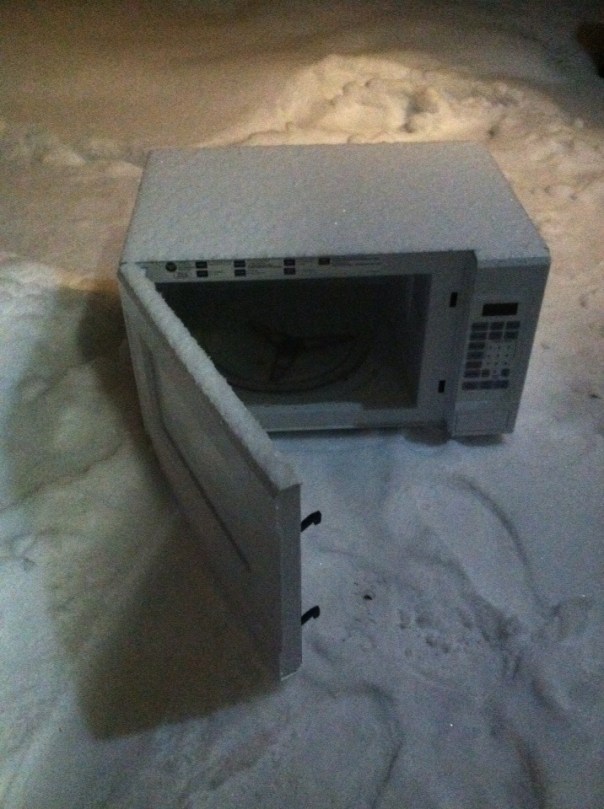
Now that’s what I call a “Frozen Dinner”. (Someone needs to photoshop ‘Olaf’ into the interior for me… or just use your imagination.)
According to my microwave, half-an-inch of snow has fallen in the past hour. No, my oven doesn’t possess space-age technology allowing it to pop the Orville Redenbacher while simultaneously measuring the barometer looking for a warming trends. In fact, it’s not even capable of popping corn correctly. Which is why my microwave is sitting outside in the snow and my windows are open to the elements in hopes I won’t set off the very expensive, ear-piercingly loud fire alarms.*
The reason my microwave is melting a rectangle of water outside my door (that it will no doubt freeze in place overnight), is because I dared to dream. After a day of ‘getting stuff done’ and ‘being responsible’, I decided to take a break, sit down, and watch a movie with my son. Then Netflix froze up and I thought that, while it rebooted, I would make a snack…
Apparently Netflix decided I didn’t deserve to see the ending of “Home” and, while I was fiddling with that, the microwave set its phazers to ‘obliterate’ and my sweet-and-salty popcorn did a Vesuvius. Distracted by ‘the purple screen of death’, I hear my son shutting off the microwave—a favorite thing of his to do. I’m turning to yell at him when I realize billows of black smoke are pouring out through the side vents. Anticipating my curses, the child turns the microwave back on. Of course, I yelled at him anyway…
“No! It’s okay to turn it off when it’s on fire!”**
So, I’m sitting in my snow suit, waiting for the smoke to clear and hoping that, if I ever again get the bright idea to try and have a relaxing evening, I will just skip it and go to bed. Apparently the Gods of Irony have me on speed dial.
Single Serving = “You’ve Been Served!”
Asterisk Bedazzled Footnote:
*My kitchen appliances really ought to come with built-in fire alarms and extinguishers. It would save time.
**One of these days I am going to write a book, Words I Never Thought Would Come Out of My Mouth. The first chapter will be entitled, “That’s Not Food”.
—–&&&&&——-
Please admire my new topic category: “Highly Flammable“. I see great things in my future with this one!